K-Drama Budgets Soar: 20% Increase for US Distribution by 2026

Anúncios
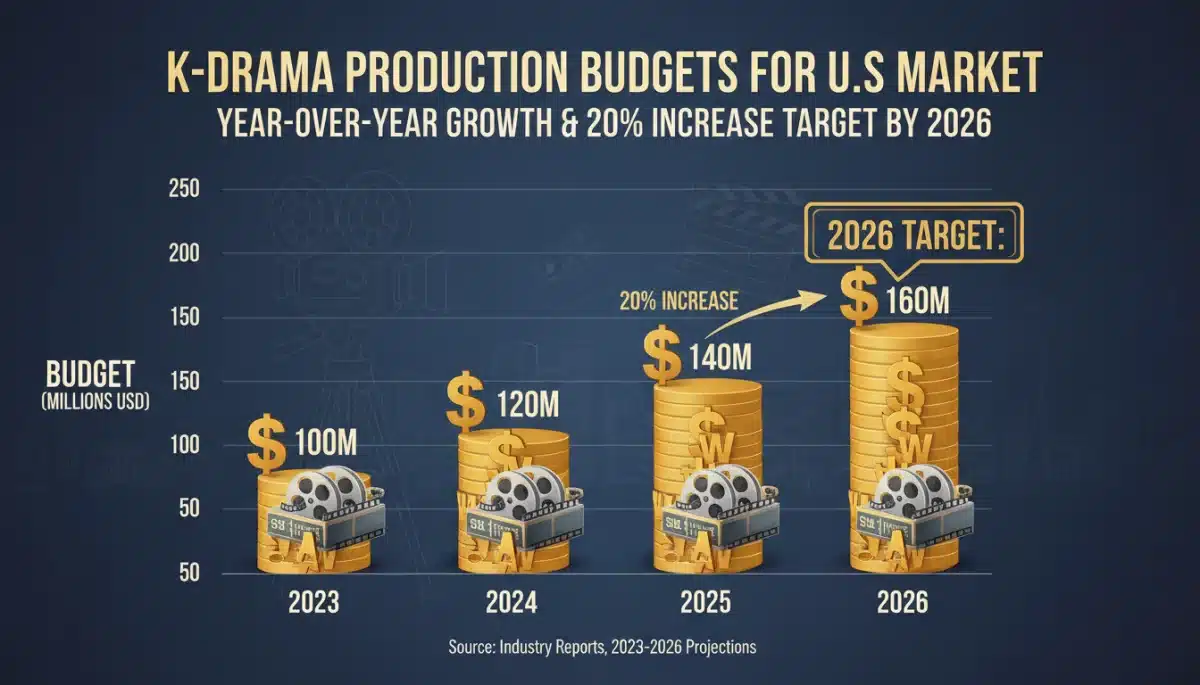
The global appetite for Korean dramas is driving a projected 20% surge in production budgets for U.S.-distributed content by 2026.
Backed by new industry data, this report cuts through the market shifts to explain what has changed, why these financial investments matter, and what indicators to track next as streaming platforms reshape international entertainment.
Unpacking the 20% Surge in K-Drama Budgets
The entertainment industry is buzzing with the news: a significant 20% increase in K-drama production budgets is earmarked for U.S.-distributed content by 2026.
This substantial financial injection reflects a confluence of factors, from escalating global demand to strategic investments by major streaming platforms.
This surge is not merely an incremental adjustment; it represents a fundamental re-evaluation of K-drama’s value proposition in the international market.
The strategic allocation of these funds is expected to elevate production quality, attract top-tier talent, and enhance storytelling.
The implications are far-reaching, impacting everything from casting choices to visual effects, ultimately benefiting the American viewership with a richer and more immersive viewing experience.
The K-Drama Budgets Increase is a direct response to market trends.
Driving Forces Behind the Budgetary Boost
Several key factors are converging to propel this dramatic increase in K-drama production budgets for U.S. distribution.
Foremost among these is the undeniable global phenomenon known as the Hallyu Wave, which has firmly established K-dramas as a mainstream entertainment force.
Streaming giants like Netflix, Disney+, and HBO Max are heavily investing in original Korean content to attract and retain subscribers, recognizing the immense appeal and rewatchability of these series.
These platforms are actively seeking high-quality, culturally rich narratives that resonate with diverse audiences.
The competitive landscape among these platforms further fuels the budget escalation, as they vie for exclusive rights to compelling K-drama projects, thereby contributing significantly to the overall K-Drama Budgets Increase.
- Global streaming platform competition intensifies.
- Proven track record of K-drama success on international charts.
- Increased demand for diverse, non-English language content.
Strategic Investments by U.S. Distributors
U.S. distributors are no longer merely acquiring existing K-dramas; they are actively co-producing and investing upfront in projects tailored for American audiences.
This shift from simple licensing to direct investment highlights a deeper commitment to the genre.
This strategic pivot allows distributors greater creative input and ensures content aligns with Western viewing habits while retaining its authentic Korean essence.
Such collaborations are instrumental in driving the projected K-Drama Budgets Increase for 2026.
The aim is to create K-dramas that transcend cultural barriers, offering universal themes wrapped in unique Korean storytelling.
This approach maximizes appeal and return on investment for all parties involved.
The Role of Major Streaming Platforms
Platforms like Netflix have been pioneers in identifying and cultivating K-drama talent and production capabilities.
Their early investments paved the way for the current surge, demonstrating the profitability of high-quality Korean content.
Netflix’s strategy involves both acquiring popular existing K-dramas and funding original series, often with significant budgets.
This commitment has not only broadened K-drama’s global reach but also pushed the boundaries of production quality.
The success of titles like ‘Squid Game’ and ‘The Glory’ has provided irrefutable evidence of K-drama’s international appeal, validating the substantial financial commitments and further contributing to the K-Drama Budgets Increase.
Impact on Production Quality and Storytelling
The 20% increase in K-drama budgets is expected to have a transformative effect on the overall quality of production. Higher budgets translate directly into better special effects, more elaborate sets, and superior cinematography.
This financial boost also enables producers to attract more renowned writers, directors, and actors, elevating the caliber of storytelling and performances. The result will be K-dramas that are visually stunning and narratively rich.
Audiences can anticipate more ambitious projects, exploring diverse genres and complex narratives that were previously constrained by limited financial resources.
This significant K-Drama Budgets Increase will redefine industry standards.
Enhanced Visuals and Special Effects
With increased financial backing, K-drama productions can now allocate substantial portions of their budgets to advanced visual effects and CGI.
This is particularly crucial for genres like fantasy, sci-fi, and historical dramas, which often rely heavily on immersive visual experiences.
The ability to invest in cutting-edge technology and skilled VFX artists will allow K-dramas to compete more effectively with Hollywood productions in terms of visual spectacle.
This elevates the viewing experience, making K-dramas even more appealing to a global audience.
The impact of this enhancement will be evident in every frame, from breathtaking landscapes to intricate action sequences. This improvement is a direct consequence of the K-Drama Budgets Increase.

Attracting Top-Tier Talent and Global Collaboration
A higher budget pool naturally attracts more celebrated scriptwriters, directors, and actors, both within Korea and internationally. This talent migration is set to diversify the creative teams behind U.S.-distributed K-dramas.
Collaborations with international artists and crew members are also expected to become more frequent, fostering a cross-cultural exchange of ideas and techniques. This global synergy will enrich K-drama content further.
The increased financial incentives will also allow for more extensive pre-production and post-production phases, ensuring meticulous attention to detail and polish.
This will undoubtedly enhance the final product, driven by the K-Drama Budgets Increase.
Casting Global Stars and Expanding Reach
The ability to offer competitive salaries enables K-drama productions to cast not only Korea’s most sought-after stars but also potentially integrate international actors. This widens the appeal of the series to a broader, more diverse audience.
Moreover, top-tier talent often brings with it a built-in fanbase, further boosting viewership and social media engagement for U.S.-distributed K-dramas. This strategic casting decision is a direct benefit of the enhanced budgets.
The combined star power and elevated production values create a potent formula for global success, ensuring that K-dramas continue to capture hearts worldwide. The K-Drama Budgets Increase plays a crucial role in this.
Market Dynamics and Future Projections
The 20% increase in K-drama budgets for U.S. distribution by 2026 is a strong indicator of sustained market confidence and growth. Industry analysts project this trend to continue, potentially leading to even greater investment in the coming years.
The success metrics, including viewership numbers, subscriber growth, and critical acclaim, consistently demonstrate a positive return on investment for K-dramas. This data reinforces the financial decisions made by distributors.
As the global entertainment landscape evolves, K-dramas are poised to play an even more central role, solidifying their position as a powerhouse in content creation. This trajectory is firmly supported by the ongoing K-Drama Budgets Increase.
Anticipated Growth and Investment Trends
Beyond 2026, experts predict that the investment in K-drama production will likely continue its upward trajectory. The proven profitability and cultural impact of these series make them an attractive asset for media companies.
We may see more specialized production houses emerge, focusing solely on creating K-dramas for international markets, further streamlining the production process and optimizing budgets. This specialization will lead to even more innovative content.
The continuous innovation in storytelling and production techniques, coupled with consistent audience engagement, ensures that the momentum behind the K-Drama Budgets Increase will not wane anytime soon.
Challenges and Opportunities for K-Drama Production
While the increase in budgets presents numerous opportunities, it also brings certain challenges. Managing larger sums requires sophisticated financial oversight and strategic planning to ensure efficient resource allocation.
The pressure to deliver high-quality content that justifies these increased investments will also intensify. Production companies must continually innovate to meet and exceed audience expectations.
However, these challenges are outweighed by the immense opportunities to push creative boundaries, explore new narratives, and further cement K-drama’s global appeal. The K-Drama Budgets Increase necessitates careful navigation.
Navigating Increased Expectations and Competition
With more money on the table, the stakes are higher. K-drama productions will face increased scrutiny from both critics and audiences, demanding originality, compelling plots, and stellar performances.
This heightened expectation can be a double-edged sword.
Furthermore, the booming market means more competition among production companies vying for talent, resources, and distribution deals. Staying ahead requires constant innovation and a keen understanding of global audience preferences.
Successfully navigating these pressures will be crucial for long-term success and for fully leveraging the benefits of the significant K-Drama Budgets Increase.
Long-Term Implications for the Hallyu Wave
The substantial K-Drama Budgets Increase for U.S.-distributed content is poised to have profound long-term implications for the Hallyu Wave. It signals a maturation of the industry, moving beyond niche appeal to mainstream dominance.
This financial commitment fosters sustainable growth, ensuring a steady stream of high-quality content that can continually captivate global audiences. It also strengthens Korea’s position as a cultural exporter.
The ripple effect extends to other aspects of Korean culture, including music, fashion, and cuisine, as K-dramas serve as a powerful gateway for global discovery. This sustained investment is key to the future of the Hallyu Wave.
Cultural Exchange and Global Influence
As K-dramas become more accessible and refined through increased budgets, their role in facilitating cultural exchange deepens.
They offer a window into Korean society, traditions, and contemporary issues, fostering greater understanding and appreciation worldwide.
This cultural soft power has tangible economic benefits, driving tourism and demand for Korean products. The enhanced production quality ensures that these cultural narratives are presented in the most compelling way possible.
The K-Drama Budgets Increase is not just about entertainment; it’s about strengthening cultural ties and solidifying Korea’s influence on the global stage.
| Key Point | Brief Description |
|---|---|
| Budget Surge | 20% increase in K-drama production budgets for U.S. distribution by 2026. |
| Driving Factors | Global demand, streaming platform investments, and Hallyu Wave momentum. |
| Production Impact | Higher quality visuals, better talent, and more ambitious storytelling. |
| Long-Term Outlook | Sustained growth, cultural exchange, and increased global influence. |
Frequently Asked Questions About K-Drama Budgets
The substantial increase stems from surging global demand for K-dramas, aggressive investment by major U.S. streaming platforms like Netflix, and the proven profitability of high-quality Korean content. This reflects a strategic move to capitalize on the Hallyu Wave’s enduring popularity and expand market reach.
Higher budgets will lead to enhanced production values, including superior visual effects, more elaborate sets, and better cinematography. It also allows for attracting top-tier writers, directors, and actors, resulting in more sophisticated storytelling and overall higher-quality productions for American audiences.
Major streaming platforms such as Netflix, Disney+, and HBO Max are at the forefront of this investment trend. They are actively co-producing and funding original K-drama content to enhance their libraries and attract subscribers, recognizing the immense appeal of these series to a global audience.
This strategic financial commitment solidifies the Hallyu Wave’s presence and growth in the U.S., moving it further into mainstream entertainment. It promises a continuous flow of diverse, high-quality K-dramas, strengthening cultural exchange and expanding Korea’s soft power influence globally.
Increased budgets bring challenges such as heightened pressure to deliver exceptional content, intense competition for top talent and resources, and the need for meticulous financial management. Producers must innovate constantly to meet elevated audience expectations and justify significant investments.
Looking Ahead: The Evolving K-Drama Landscape
The projected 20% K-Drama Budgets Increase for U.S.-distributed content by 2026 marks a pivotal moment for the entertainment industry.
This financial injection signals a robust commitment to Korean content, promising an era of unprecedented quality and narrative depth.
As streaming platforms continue to prioritize global content, K-dramas are increasingly becoming a cornerstone of their offerings, driving subscriber growth and cultural exchange.
This trend is set to redefine international entertainment consumption. However, this aggressive expansion comes with structural risks, as skyrocketing production fees place severe economic strain on domestic broadcasters.
For a deeper look into how these cost pressures are impacting traditional networks in South Korea, read about JTBC’s financial troubles raising alarms for the K-drama industry via The Korea Times.
Investors, producers, and audiences alike should monitor how these increased budgets translate into new creative benchmarks and further solidify K-drama’s dominant position in the global market.
The future of K-dramas in the U.S. looks exceptionally bright.